Law school courses aside, most acumen for DWI defense attorneys is gained from practical experience within the courtroom. DWI cases in particular are considered some of the most challenging cases to defend, mainly because of the many variables and outside factors that must be considered, as well as the social and public stigma associated with DWI. Knowledge of the law is often not enough for a solid defense. Science factors in a great deal when determining if a DUI charge is valid.
Because DUI cases can be so complicated, attorneys can make mistakes when defending their clients. These mistakes can be costly to the client in terms of license suspension, jail time, and large financial burdens. It is important to get the facts about what mistakes can be made in a DUI case and use those facts when deciding which attorney would work best for your particular case. The following are 9 common errors made by attorneys in DUI cases, and suggestions on how to avoid them.
1. Thinking the Case Is Not Winnable
Many attorneys advise their clients to plead guilty to the DUI charge strictly on the basis of test results or police reports. This can be a costly mistake if the guilty plea affects the client’s livelihood as well as his or her wallet.
The fact is that breath, blood and urine tests, and roadside sobriety tests can be flawed, and these flaws can be used to build a solid defense in a DUI case. Test results can be challenged, police officers can be cross-examined, and defense experts can be brought in to provide further evidence as to whether procedures were followed correctly in all aspects of the arrest. Since it can be much more costly to plead guilty to a DUI charge than not, your attorney should not dismiss your case as a lost cause. This can be one of the most significant mistakes an attorney can make when handling a DUI case. Make sure that the attorney you choose has a strategy to actually fight your case, rather than just walk you in, hold your hand and plead you guilty.
2. Not Questioning Whether Rules for the Breath Test Were Followed
In the state of New Jersey, there are certain rules that must be followed in administering a breath test to someone suspected of DWI. If these rules were not followed, a defense can be set forth that the test results are unreliable. The test results could be thrown out of the case altogether.
The key to a successful defense is hiring a DWI attorney who has in-depth knowledge of the testing methods for the roadside physicals, and the chemical testing for blood, breath and urine, who is aware of the various ways that this testing can be administered inappropriately. The lawyers at Levow DWI Law, P.C. have extensive knowledge in the test methods and protocols. Evan Levow represented the lead defendant in State v. Chun, the landmark breath testing case from the New Jersey Supreme Court which challenged the reliability of the Draeger Alcotest® 7110 MKIII-C breath testing machine. Evan Levow was able to get the breath test results in the Chun case dismissed. Evan’s unique knowledge from the Chun case continues to help his clients achieve success.
The following are several ways in which a breath test can be considered flawed:
- The person administering the test is not currently certified to do so
- The machine does not have a current certification
- The machine has not been calibrated in accordance with required standards
- The mouthpiece was not changed prior to administering the test
- There is not an accurate record of the temperature of the solutions in the machine
- There is not an accurate log of which tests have been run
- There is not an accurate count of the number of changes in the solution
- The officer failed to properly observe you for twenty minutes prior to testing you
In order to create a proper defense in a DUI case, your attorney should obtain copies of all of the documentation involved in the logs, maintenance, and certifications of both the Alcotest breath testing machine used and the operator of the machine. Audio and video tape of the stop, arrest and processing must also be obtained and reviewed. Unfortunately, some attorneys do not fully evaluate the case, instead considering only the complaint and testing record.
3. Choosing Not to File a Motion to Suppress
Using the process to help you, rather than being overwhelmed by it. Your lawyer should know how to analyze the information against you, and truly defend you. There are many motions that can help your defense. A successful Motion to Suppress the arrest or the test results could result in a dismissal of your DWI case. Your DWI lawyer should have a plan for your defense, and should be able to advise you of the best defenses in your case.
4. Not Investigating the Arrest Location
Seeing the arrest location can be crucial in preparing a solid defense in a DUI case, yet many lawyers don’t bother taking this extra step. The location of a DUI arrest can be very telling in determining the difficulty of performing a roadside test. For example, heavy traffic or a steeply slanted shoulder of the road could both hinder adequate performance on a roadside test, while a winding road could be a valid reason for erratic driving. Assessing the scene can reveal obstacles that would make the arresting officer’s claims physically impossible, such as a claim of driving on the sidewalk in an area where a vehicle could not actually gain access to a sidewalk. Viewing the arrest scene personally can provide valuable information for an attorney to use when preparing a defense.
5. Not Knowing the Field Tests Better than the Officer that Tested You
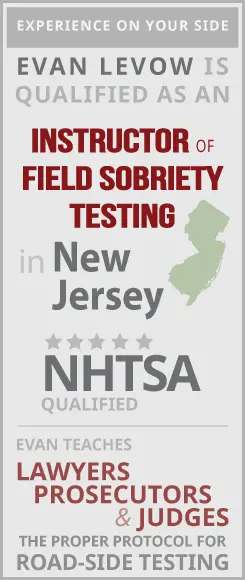
If your attorney knows the rules of field testing better than your arresting officer, your lawyer will know whether the officer made errors in your testing that can form the basis for defending your case, and possibly dismissing your DWI charge. The lawyers at Levow DWI Law, P.C. are all trained and qualified in field sobriety testing by the National Highway Safety Administration. Evan Levow was the first lawyer in the state of New Jersey to be qualified as an instructor in field sobriety testing in 2004. In fact, Evan has lectured to police officers on how to properly administer the testing. Based on our extensive knowledge of these road-side exercises, we are going to know if something was done improperly with your testing. A successful challenge of field sobriety testing evidence obtained without following proper procedure can result in the evidence being dismissed.
In addition to the possibility that the arresting officer did not follow the manual’s procedures for testing, many officers do not use objective scoring as also outlined within the manual. Instead, the officer makes the decision of whether or not the test was “failed” based on improper factors, which render the testing results unreliable.
6. The Attorney Does Not Know all of the Extra Penalties Associated With Pleading Guilty or Being Convicted
There are so many consequences that can result from a DWI conviction. It is critical that your lawyer know these consequences in order to help you. Knowing whether prior convictions, other state’s laws, employment circumstances can affect your conviction is information that may change how your case should be handled. What your lawyer does and doesn’t know will affect your DWI defense. Given the severity of some of the penalties, including driver’s license suspension or revocation, large fines, possible jail sentences, no longer being able to rent a vehicle, and higher insurance premiums, you should have all of the information necessary to make an informed decision about whether to enter a guilty plea or not. Your lawyer must know the nuances of New Jersey DWI law. The lawyers at Levow DWI Law, P.C. only practice DWI law, and are fully familiar with the ins and outs of what you can expect throughout your case and afterward.
7. Having the Client Testify if the Case Goes to Trial
If you choose to go to trial, you have a choice whether to testify or not. However, what you say can be used against you in court. Other than using a defendant’s testimony to contradict a statement by the arresting officer, the attorney would be better served concentrating on establishing weakness in the prosecutor’s case, rather than having the client testify. A testifying defendant now shifts the focus to the credibility and honesty of the defendant. It also forces the judge to choose between the defendant and arresting officer, and allows the prosecution to cross-examine the defendant and possibly weaken the DWI defense. There are some times when a client’s testimony is required, but it takes a skilled attorney to know when that risk is worth taking on behalf of the client.
8. Trying to Prove that the Arresting Officer Lied
The judge and prosecutor are more inclined to believe that a police officer may have made a mistake or jumped to conclusions. Trying to make the officer out to be a liar creates animosity that usually does not result in a positive trial outcome. Further, the client is unlikely to win a he-said/she-said scenario. The most effective approach is to use the state’s evidence to show that there is reasonable doubt as to the officer’s contentions and that the client did more good than bad regarding the client’s behavior at the time of the arrest.
9. The Attorney Does Not Consult with an Expert
A proper defense requires involving experts in certain aspects of your case. While the lawyers at Levow DWI Law, P.C. practice DWI law only, they still use the services of other DWI experts to point out flaws in the arrest process, field testing, breath testing, urine testing and blood testing. It is a mistake not to involve experts in a DWI defense. Consulting with and getting written opinions from these experts can help to weaken the prosecutor’s case. The reports from the experts may provide a reason for the prosecutor to back away from the charges against you, or it can provide a road map on how to defend and go to trial in a DWI case, when necessary.
DUI is a serious offense involving complex laws and scientific information. Attorneys who dedicate their practice to DUI will have the knowledge and experience to know what to look for when preparing a defense, will know how to create the strongest case possible, and will likely not make the mistakes listed in this article.
Please call a New Jersey DWI attorney at Levow DWI Law, P.C. today for a free consultation